 Skip to content
July 7, 2026
How Do Integrated Video Surveillance Systems Protect High-Security Facilities?
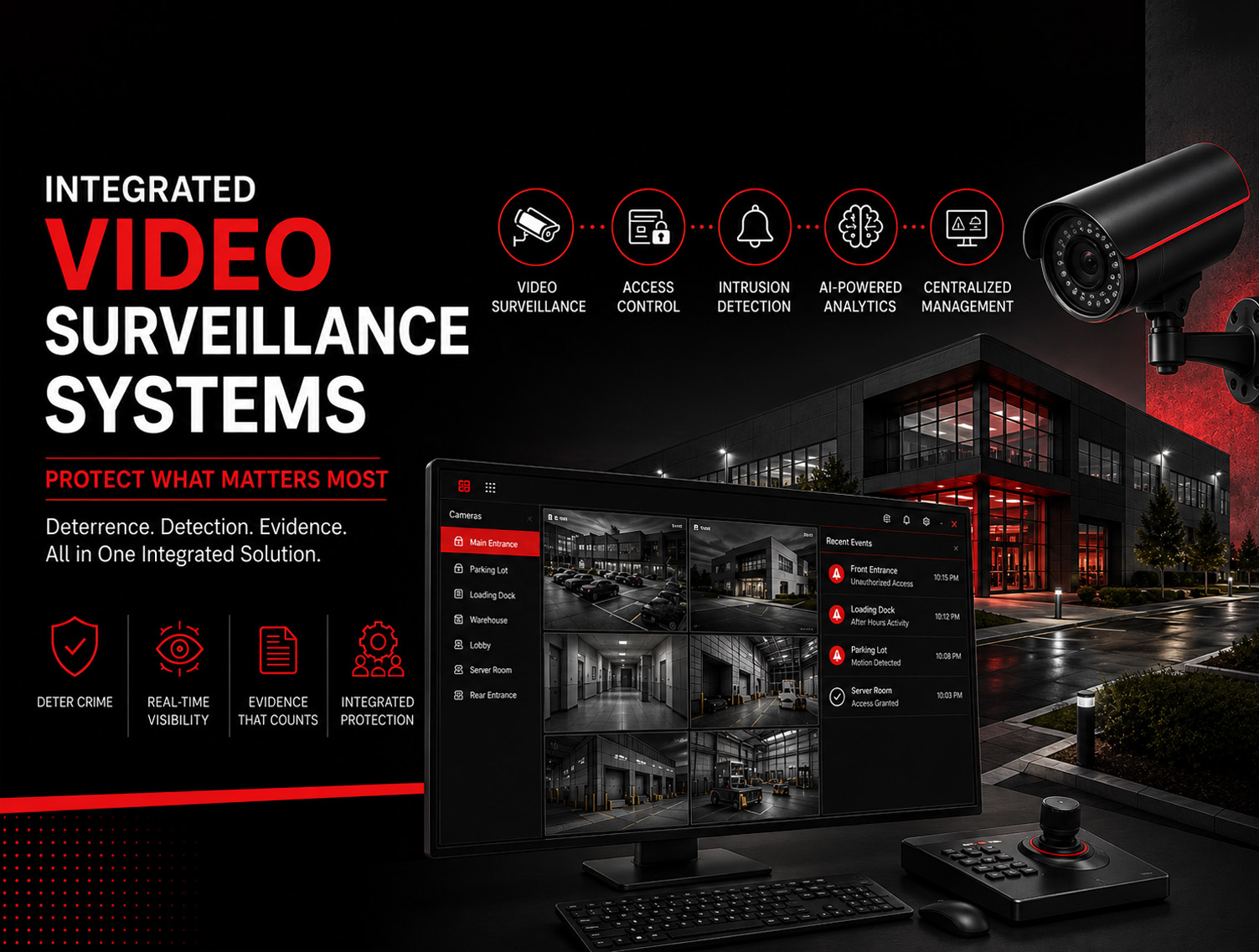
Integrated video surveillance systems protect high-security facilities by connecting IP cameras, access control, intrusion detection, and AI-enabled analytics into a single centralized platform. This unified approach gives security teams real-time visibility across entrances, restricted zones, loading docks, and multi-site operations, all managed from one dashboard rather than through disconnected systems.
High-security industries including healthcare, manufacturing, Department of Defense contractors, and K–12 education, require surveillance systems designed around facility-specific risks, compliance frameworks, and long-term maintenance programs. Camera placement, integration depth, and lifecycle support all determine whether a system performs under real operational pressure or creates the illusion of security without delivering it.
Key Takeaway: Effective facility security is not defined by the number of cameras installed — it is defined by how well those cameras communicate with access control, intrusion detection, and analytics platforms across your entire operation. The facilities that get this right choose a security integrator, not a camera vendor.
High security commercial facilities including healthcare campuses, data centers, manufacturing plants, government buildings, and school districts, face security challenges that basic camera installations cannot address. Fragmented technologies, blind spots, and disconnected platforms slow incident response and create accountability gaps that compound over time.
Modern video surveillance services solve this by unifying cameras, access control, analytics, and alerts into centralized platforms that improve situational awareness across entire properties. The right outcome depends on integration depth, installation expertise, and a long-term support model that keeps systems performing as facilities grow and evolve.
This guide covers four core areas: how surveillance deters theft and fraud, what separates qualified CCTV installation companies from generic hardware vendors, how healthcare facilities evaluate systems for long-term use, and how high-security environments build integrated protection that works.
Cobalt FTS offers a free security assessment for commercial facilities across North Texas.
→ GET A FREE ASSESSMENT
How Video Surveillance Systems Help Deter Theft, Fraud, and Unauthorized Access
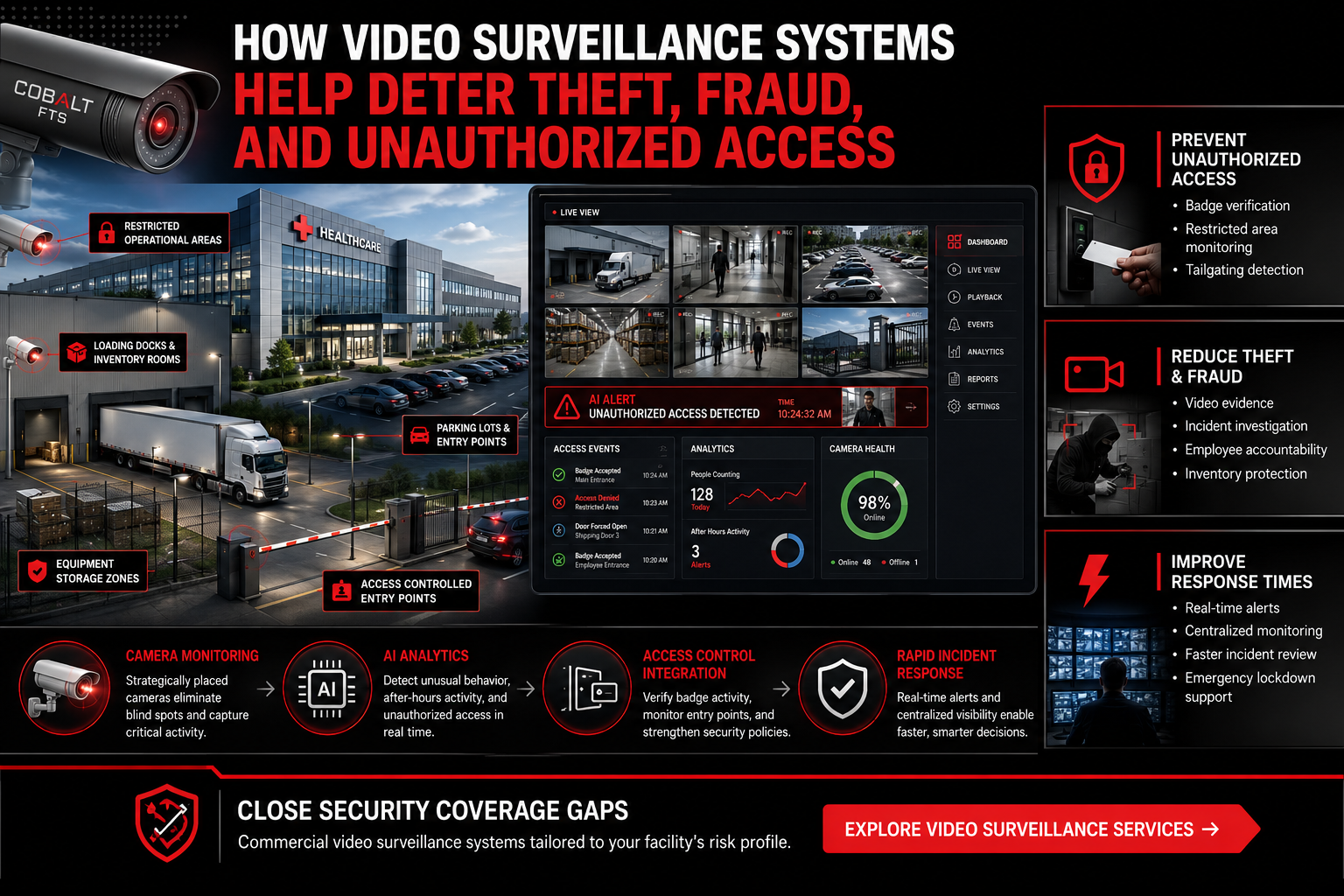
Commercial properties face growing security challenges across multiple industries. Healthcare campuses, warehouses, manufacturing facilities, and schools all manage valuable assets and sensitive areas daily. Our commercial video surveillance systems help organizations monitor activity, reduce blind spots, and improve incident response times — while also supporting investigations, employee accountability, and access control management without disrupting daily operations.
The Deterrence Effect of Visible Surveillance
The visible presence of cameras often discourages criminal behavior before incidents occur. Employees, visitors, and contractors tend to follow security policies more carefully when surveillance systems are active.
Strategically placed cameras monitor the locations where risk concentrates:
- Loading docks and inventory rooms
- Parking lots and entry points
- Restricted operational areas
- Cash handling locations
- Equipment storage zones
Recorded footage helps security teams verify incidents quickly, reducing delays during investigations and supporting accurate reporting. Organizations with multiple facilities benefit from our integrated security platform — security personnel can review activity from one dashboard instead of managing disconnected systems.
Why CCTV Systems Matter for Fraud Prevention
Fraud can occur internally or externally. Inventory manipulation, unauthorized transactions, and policy violations may go unnoticed without reliable monitoring systems. Commercial CCTV systems help organizations document activity with time-stamped video evidence, creating stronger accountability across departments and operational teams.
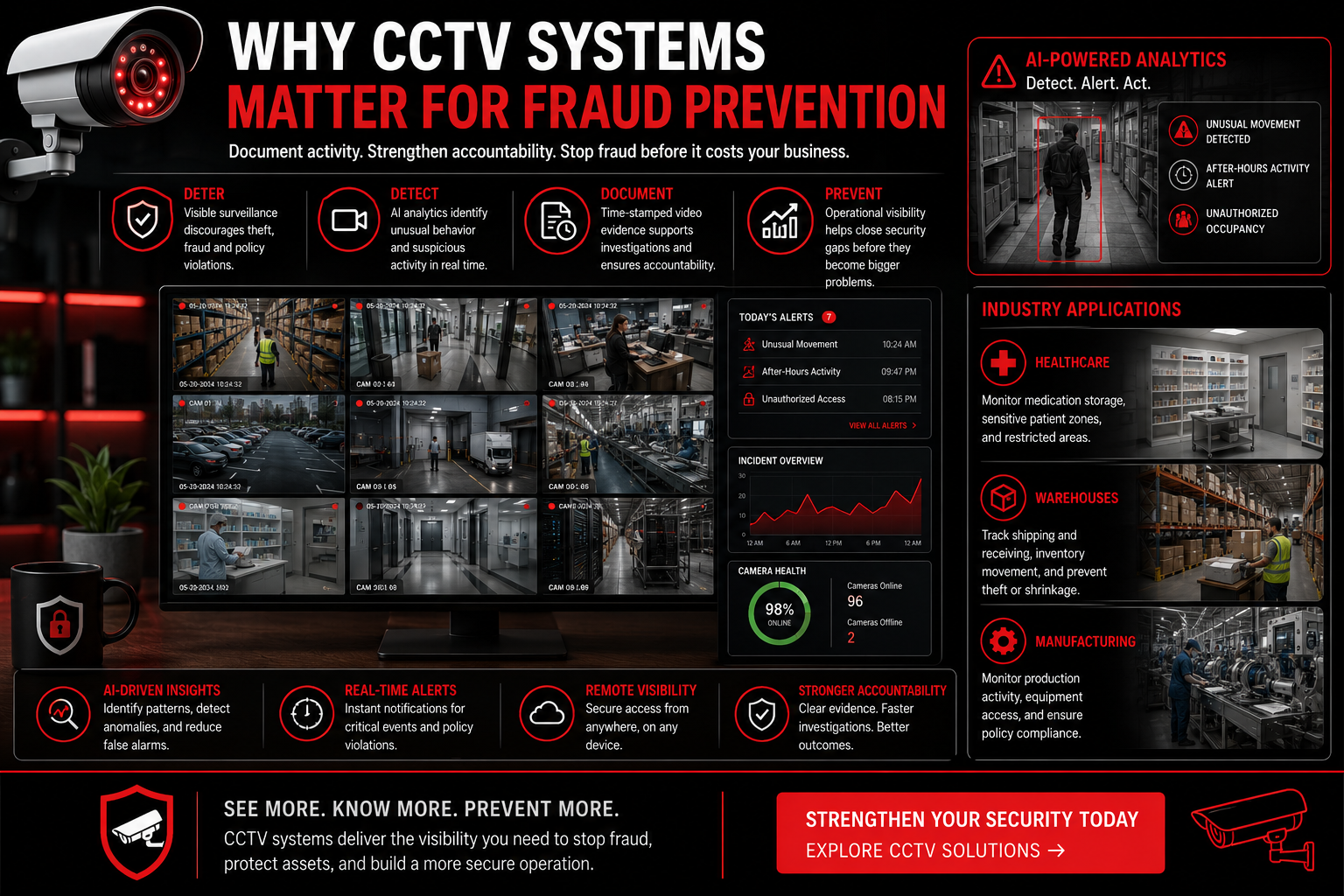
The application varies by industry. Our healthcare security programs are designed to monitor medication storage areas and sensitive patient zones. Warehouses track shipping and receiving operations. Our manufacturing facility security solutions cover production activity and restricted equipment access.
Modern systems also support AI-driven analytics that identify unusual movement patterns, after-hours activity, or unauthorized occupancy in sensitive zones. Businesses gain more than recorded footage — they gain operational visibility that identifies security gaps before they become larger problems.
Integrating Surveillance with Access Control
Video surveillance works best when connected directly to your access control system. A unified security environment helps organizations verify badge activity with video footage, monitor unauthorized entry attempts, review tailgating incidents, support emergency lockdown procedures, and strengthen visitor management.
This approach eliminates fragmented security operations. Teams no longer need to switch between multiple platforms during active incidents. Cobalt FTS builds integrated security ecosystems that support centralized visibility through unified dashboards, allowing operators to manage surveillance, alerts, and access events from a single platform.
What to Look for in a Commercial Video Surveillance Installation Company
Not all surveillance providers offer long-term integration expertise. A qualified commercial video surveillance installation company should provide security consulting and system planning, integration with existing infrastructure, long-term maintenance support, vendor-agnostic recommendations, and scalable monitoring solutions.
Security requirements vary across industries. Our school and university security programs often prioritize visitor management and vape detection. Data centers often require layered access monitoring and redundant coverage. Our manufacturing security solutions focus on perimeter protection and operational visibility. The right integrator helps organizations align surveillance systems with operational risks and compliance requirements.
Cobalt FTS designs commercial security camera systems tailored to your facility’s specific risk profile.
→ EXPLORE VIDEO SURVEILLANCE SERVICES
How to Select the Right CCTV Installation Company for High-Security Facilities
Healthcare campuses, data centers, government buildings, and manufacturing facilities face complex security risks that standard camera setups cannot address. High-security environments require systems that connect surveillance with a fully integrated access control platform, real-time alerts, and AI-enabled analytics — all managed from one centralized interface. Many organizations focus only on camera quality — but long-term performance depends on integration capabilities, monitoring support, and scalability.
What Businesses Should Evaluate in a CCTV Installation Company
Not every provider offers the same level of integration expertise. Some companies install hardware without planning for future growth or system compatibility. When evaluating providers, businesses should consider:
- Experience serving healthcare, schools and universities, manufacturing, and Department of Defense environments
- Ability to integrate access control and intrusion detection into a unified platform
- AI-enabled video analytics capabilities
- Long-term maintenance and lifecycle support
- Vendor-agnostic system recommendations
- Centralized monitoring dashboards
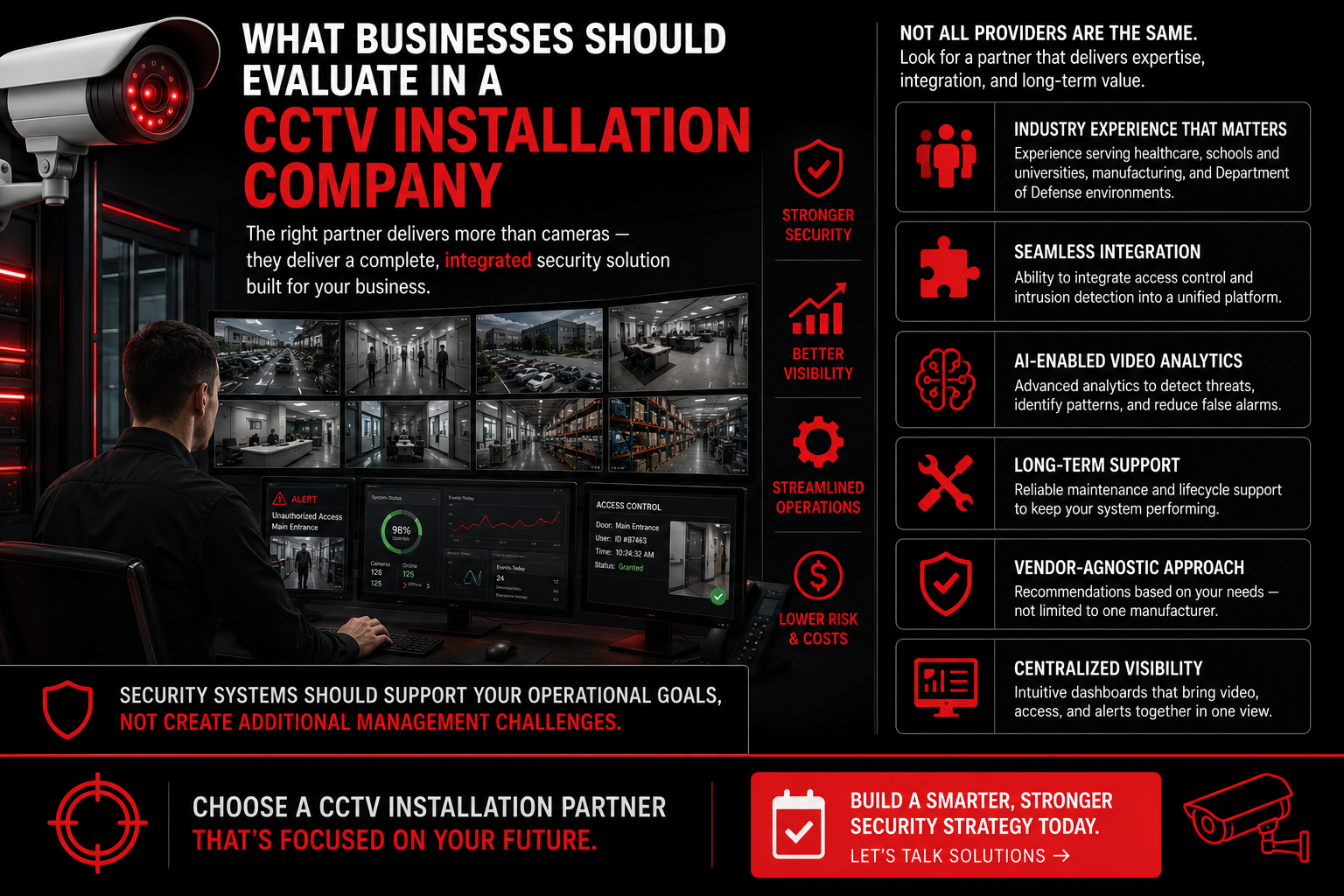
Security systems should support operational goals, not create additional management challenges
Why System Integration Defines Modern Surveillance Performance
Modern facilities rarely operate with surveillance alone. Cameras now work alongside card readers, visitor management platforms, and intelligent detection tools. When these systems are unified through an integrated security architecture, security teams can connect access events, video footage, and alerts through a single interface during emergencies.
Facilities with siloed systems consistently struggle with slower response times and inconsistent monitoring workflows. Cobalt FTS builds integrated physical security ecosystems that combine video surveillance, access control, and AI-enabled analytics into centralized platforms designed specifically for high-security environments.
Why Industry Experience Changes the Outcome
Our healthcare security programs are designed around controlled access zones, visitor tracking, real-time surveillance monitoring, and compliance-focused system design. Our manufacturing and logistics security solutions prioritize perimeter visibility, license plate recognition, multi-building surveillance coverage, and after-hours monitoring. For Department of Defense contractors, we design layered physical security architectures that meet stringent access and documentation standards.
The best CCTV installation companies understand these operational differences and build systems around facility-specific risks rather than applying a generic template across every engagement.
Evaluating Long-Term Support and Maintenance
Security systems require ongoing monitoring, software updates, and maintenance. Organizations should confirm whether the provider offers proactive maintenance, whether the system can scale with future growth, whether legacy infrastructure is supported, and whether firmware updates will be managed proactively.
Long-term support reduces operational disruptions and helps facilities avoid silent system failures that go unnoticed until an incident reveals the gap.
❝ Cobalt FTS has best-in-the-business crew from sales to service. They listen to your needs, provide a comprehensive and honest review, and get the job done on time and with great communication. Skilled technicians show up to work on your issues whether it is CCTV, alarm, fire, or security, and it is hard to find these days. ❞
— Derek, Corelogic
Talk to Cobalt FTS about integrated security design for your specific facility and industry.
→ TALK TO COBALT FTS
How Healthcare Facilities Evaluate Video and CCTV Surveillance Systems for Long-Term Security
Outdated security infrastructure leaves critical medical environments vulnerable to undetected physical threats, and the operational cost of that exposure compounds over time. When fragmented camera networks fail to communicate with your access control infrastructure, security teams lose the situational awareness needed to respond decisively.
Healthcare security directors and procurement officers increasingly recognize that upgrading these networks is not a capital expense to defer. Visibility across patient care areas, staff corridors, and entry points is a baseline operational requirement. The evaluation process must account for scalability, integration depth, and long-term vendor support not just upfront hardware specifications.
Why Healthcare Facilities Upgrade Legacy CCTV Infrastructure
Legacy analog CCTV systems consistently underperform in environments like those we design for in our healthcare security program — where image clarity, remote visibility, and coverage density are non-negotiable. Blind spots in high-traffic zones create accountability gaps that are difficult to resolve after an incident. Advanced video surveillance systems equipped with intelligent analytics shift the security posture from reactive to proactive, detecting perimeter anomalies before situations escalate.
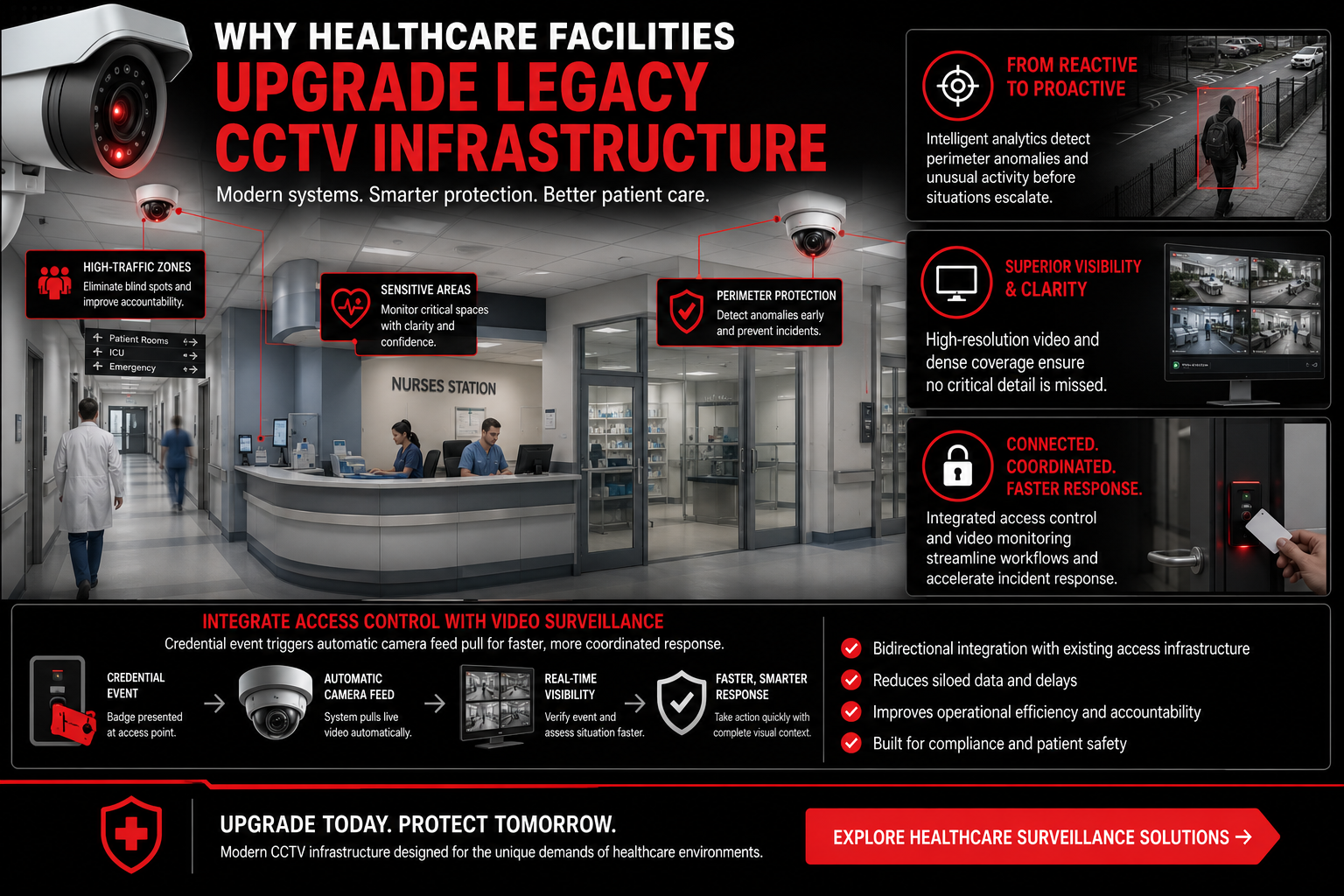
Connecting your access control system with visual monitoring is widely recognized as best practice. When a credential event triggers an automatic camera feed pull, incident response becomes meaningfully faster and more coordinated. Facility managers should prioritize systems that support bidirectional integration with existing access infrastructure, reducing the risk of siloed data and delayed response.
How Video Surveillance Systems Support Healthcare Compliance
Privacy regulations governing healthcare environments impose strict requirements on how surveillance data is stored, accessed, and retained. Modern surveillance platforms should support encrypted transmission, role-based access controls, and audit-ready activity logging to maintain compliance standards. Facilities that cannot produce clear access records during a compliance review face increased operational and regulatory risk.
Camera placement strategy is equally important. Proper positioning monitors entrances, waiting areas, pharmacy counters, server rooms, and staff-only corridors without compromising patient privacy. Procurement teams should request documented placement plans and compliance-focused system designs as part of the evaluation process.
Deploying Systems Through Professional Video Surveillance Installation Services
Professional installation services help the healthcare facilities we serve modernize aging CCTV infrastructure while reducing compatibility risks during migration. Experienced integrators assess existing infrastructure, identify legacy hardware conflicts, and design architectures that support phased deployment without service interruption. Facilities that skip a formal site survey frequently encounter integration failures that extend project timelines and increase total cost.
Proactive maintenance packages carry significant lifecycle weight. Hardware operating without scheduled firmware updates and physical inspections degrades faster and introduces unplanned downtime risk at critical moments. Facility managers should negotiate service-level agreements that include defined response windows and preventive maintenance cadences — not just break-fix coverage. The right installation partner functions as a long-term operational asset, not a one-time vendor.
The same level of commitment we deliver in healthcare applies across our school and university security programs — where ongoing service, communication, and technical precision are equally critical.
❝ Cobalt FTS has been an exceptional partner for our school district. Their commitment to customer service is evident in every interaction, and their leadership team sets the tone with clear, consistent communication that keeps projects moving smoothly. The technicians at Cobalt FTS are equally impressive, and their expertise, responsiveness, and attention to detail ensure our access control systems are reliable and secure. ❞
— Clint, Allen ISD
Cobalt FTS designs compliance-ready surveillance systems built around the specific demands of your environment.
→ EXPLORE HEALTHCARE SECURITY SOLUTIONS
How Video Surveillance Systems Protect High-Security Facilities
High-security facilities face constant operational and security challenges. Healthcare campuses, data centers, the manufacturing plants we protect, government and DoD facilities, and educational institutions all manage large properties, restricted zones, and continuous activity. Effective surveillance supports situational awareness, operational continuity, and faster decision-making during security events.
How Integrated Surveillance Improves Facility Visibility
Large facilities generate constant movement throughout the day. Our commercial video surveillance systems provide continuous monitoring across entrances, loading docks, hallways, parking areas, server rooms, and restricted locations. Security teams access real-time footage and historical recordings from one interface.
Many organizations integrate surveillance directly with their access control platform. When a badge reader grants or denies entry, the associated camera footage becomes immediately available allowing operators to verify events quickly and investigate incidents more efficiently across both single-site and multi-site operations.
What Risks CCTV Surveillance Systems Help Reduce
Security risks vary by facility type. The manufacturing facilities we serve prioritize perimeter monitoring and inventory protection. Our healthcare security programs focus on patient safety and restricted access management. For DoD and government contractors, we provide constant monitoring around sensitive infrastructure and controlled access zones.
Properly designed CCTV surveillance systems help reduce:
- Unauthorized access to restricted areas
- Theft and property damage
- Workplace violence incidents
- Tailgating and credential misuse
- Parking lot and perimeter security gaps
- Vandalism and trespassing
- Delayed emergency response coordination
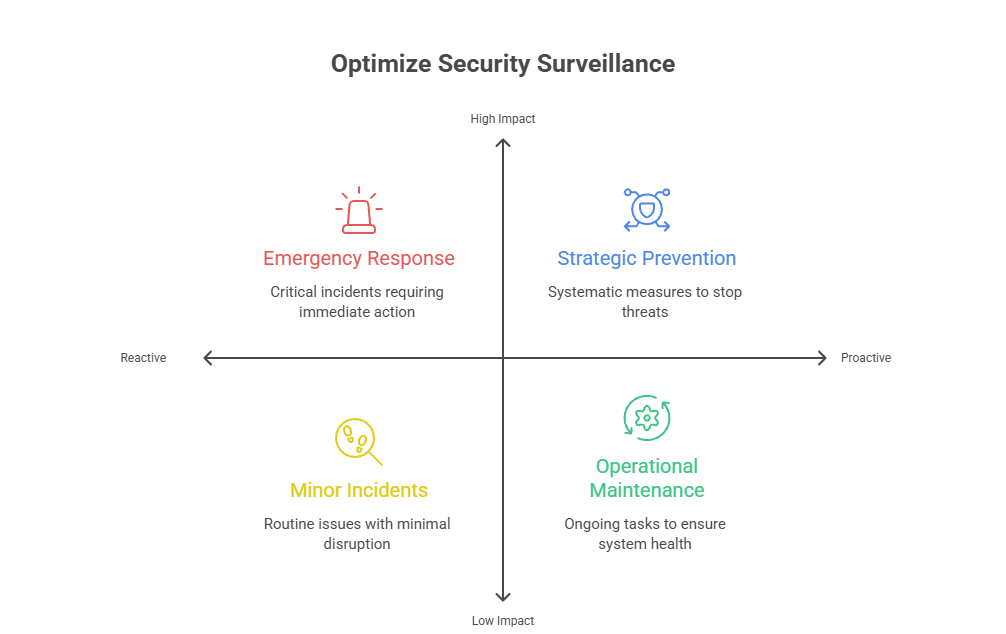
Camera placement, analytics configuration, lighting conditions, and system integration all influence performance. Poorly designed deployments create coverage gaps or overwhelm operators with unnecessary alerts, which is why working with an experienced integrator consistently produces better outcomes than isolated hardware installations.
Why System Integration Is Non-Negotiable
Our integrated security systems allow cameras, card readers, intrusion detection devices, intercoms, and visitor management platforms to share information in real time. This “one pane of glass” approach improves incident coordination operators review access events, alarms, and footage from a single dashboard rather than jumping between disconnected systems.
For facilities requiring flexible, scalable infrastructure, our cloud-based security systems extend this further enabling remote oversight and scalable storage without on-premise infrastructure constraints.
AI-Enabled Video Analytics in High-Security Environments
AI-enabled surveillance tools improve monitoring efficiency by identifying patterns and highlighting events that require human review. A manufacturing facility may use analytics to monitor restricted production zones after hours. A healthcare campus may use them to flag unauthorized access near pharmaceutical storage. Educational facilities often pair surveillance analytics with weapons detection systems or vape detection technology at entry points to create a fully layered entry security program.
AI tools should support operators, not replace them. Human oversight remains essential for validating alerts and determining appropriate responses.
Multi-Site Surveillance Management
Organizations across multiple locations often face inconsistent security standards — separate camera platforms, recording systems, and monitoring procedures that create operational inefficiencies and limit visibility across the organization. Our integrated security platform standardizes monitoring practices across all sites, enabling security administrators to manage permissions, review footage, and monitor alerts from a single unified interface.
Key considerations for multi-site surveillance include centralized monitoring capabilities, consistent access permissions, standardized reporting workflows, scalable storage management, network reliability between facilities, and cybersecurity protections for connected systems.
Why Ongoing Maintenance Determines Long-Term Reliability
Without regular maintenance, surveillance systems can fail when they are needed most, resulting in missing footage or non-functional cameras during critical incidents. Routine maintenance includes checking recording quality, storage capacity, analytics performance, and camera positioning. Regular software updates and cybersecurity patching also help keep connected surveillance systems secure, reliable, and operating at peak performance.
❝ We appreciate the relationship we’ve built with Cobalt FTS and highly recommend their services to any organization seeking dependable and expert security solutions. ❞
— Teresa, Blackbox
Hear more from the organizations we protect on our customer testimonials page.
Cobalt FTS builds integrated surveillance programs that scale with your operations and keep pace with evolving threats.
→ REQUEST A FREE ESTIMATE
How Long-Term Surveillance Planning Strengthens Facility Security
Security systems require ongoing evaluation and maintenance. Camera coverage, analytics configurations, and access permissions should evolve alongside facility operations. Organizations that treat a surveillance installation as a finished project rather than a managed program consistently develop blind spots over time.
Our integrated security systems improve incident documentation and response coordination in ways that reactive, hardware-only approaches cannot replicate. Footage retention supports legal and HR processes. Access event logs support compliance audits. Analytics data informs physical security planning decisions about staffing, camera repositioning, and infrastructure investment.
Planning for this role from the outset changes how organizations approach the procurement process. Rather than selecting a camera vendor, they are selecting an operational partner whose technical capabilities and service commitment will directly affect the security program’s performance for years.
Cobalt FTS delivers lifecycle security partnerships — from system design through ongoing maintenance and support.
→ PLAN YOUR SECURITY PROGRAM
A Decision Framework for Commercial Security Camera Systems
For security directors and facility managers approaching a surveillance investment, these criteria apply across every high-security commercial environment.
- System Design First: The installation company must perform a documented site assessment and produce a design addressing coverage requirements, camera selection, network architecture, and integration touchpoints before installation begins.
- Enterprise-Grade Hardware: Camera hardware from manufacturers with documented cybersecurity programs, active firmware support, and manufacturer certification programs for their installing partners.
- Purpose-Built VMS Platform: The video management software determines what the system can do beyond basic recording. Enterprise platforms support multi-site management, advanced analytics, role-based access control, and scalable storage architecture.
- In-House Installation Workforce: Licensed, trained technicians employed by the integrator. No subcontracting for high-security or healthcare installations.
- True Integration Depth: Your access control system, intrusion detection platform, and video surveillance infrastructure must function as a single integrated system — not three separate products installed in the same building.
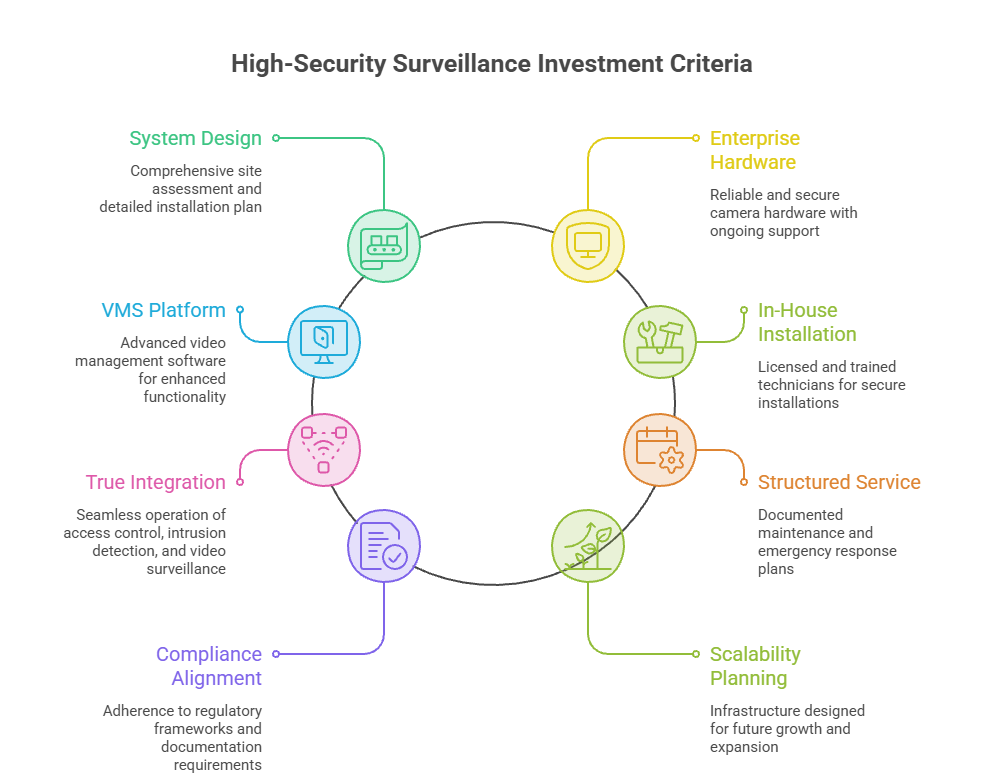
- Structured Service Model: Documented preventive maintenance schedules, defined emergency response time commitments, and a named technical contact who knows the facility’s system configuration.
- Compliance Alignment: For any regulated industry, the integrator must understand the compliance framework governing physical security and configure the system to produce the documentation that framework requires.
- Scalability Planning: Infrastructure designed to grow with your facility without rebuilding the entire system each time you expand.
Cobalt FTS can assess your existing system against this framework and identify where gaps exist.
→ GET YOUR SECURITY ASSESSMENT
Why Cobalt FTS
Cobalt FTS has been designing, installing, and maintaining commercial security camera systems across North Texas since 1998. As a state-certified security integrator with a dedicated in-house technical workforce, Cobalt FTS delivers the integration expertise, industry-specific experience, and long-term service commitment that high-security facilities require. Learn more about Cobalt FTS.
Cobalt FTS serves Department of Defense contractors, healthcare campuses, K-12 school districts and universities, and manufacturing and critical infrastructure facilities across Texas. Every system is designed to the specific requirements of the facility and industry, installed by Cobalt FTS’s own technicians, and backed by structured service and maintenance support.
Read what our customers say about working with Cobalt FTS.
From single-building commercial security camera systems to multi-site integrated security architectures, Cobalt FTS delivers end-to-end video surveillance installation services that protect people, assets, and operations.
Frequently Asked Questions
How do video surveillance systems help prevent theft and unauthorized access?
Video surveillance systems monitor critical areas, deter suspicious activity, provide recorded evidence, and help security teams respond quickly to unauthorized access attempts and security incidents.
Why is system integration important for commercial security?
System integration allows cameras, access control systems, intrusion detection devices, and security alerts to work together, improving response times and providing a unified view of security events.
What should businesses look for in a CCTV installation company?
Businesses should evaluate industry experience, integration capabilities, AI analytics support, maintenance services, scalability, and the provider's ability to design customized security solutions.
How do AI-powered video analytics improve surveillance performance?
AI-powered analytics can detect unusual activity, unauthorized occupancy, perimeter breaches, and other security events, helping operators identify potential threats more efficiently.
How can healthcare facilities benefit from modern video surveillance systems?
Healthcare facilities use surveillance systems to monitor sensitive areas, support compliance requirements, improve patient and staff safety, and strengthen access control management.
What are the benefits of centralized multi-site surveillance management?
Centralized surveillance allows organizations to monitor multiple facilities from a single dashboard, standardize security procedures, manage permissions, and review footage more efficiently.
How often should commercial surveillance systems be maintained?
Commercial surveillance systems should undergo regular inspections, software updates, cybersecurity patching, and performance testing to ensure reliable operation and prevent unexpected failures.

Recent Insights
October 1, 2026
It is tempting to think that more cameras mean more [...]
October 1, 2026
Every commercial camera system must record and store footage somewhere, [...]
August 12, 2026
Defense contractor security compliance goes beyond standard commercial security because [...]


