Skip to content

How Does Alarm Verification Work in a Commercial Security Alarm System?
November 24, 2026
A monitoring company’s pitch almost always leads with speed: how fast an alert goes out, how quickly someone gets a call. What gets glossed over is how that alert gets checked in the first place, and that’s the part that actually matters. Cobalt FTS hears this question constantly from Dallas-Fort Worth facility managers sizing up alarm monitoring companies, because racing to respond to a false alarm isn’t really winning anything. This guide explains how alarm verification works, so you know what to ask before assuming every provider handles it the same way.
People Also Ask
Why do some alarm companies charge extra for verified response?
Verification requires additional monitoring steps and sometimes extra equipment, which some providers price separately from basic monitoring.
Does verification slow down the response to a real emergency?
No, verification is designed to confirm an event quickly, which speeds up an appropriate response rather than delaying it.
What Is Alarm Verification?
This process confirms that a triggered sensor reflects an actual event before a monitoring center escalates the alert further. Rather than treating every signal the same, verification uses additional evidence, typically video footage or access control data, to distinguish a real intrusion from a false trigger. Verification exists because a fast response only helps a facility if the alert behind it turns out to be accurate.
Why Do Commercial Alarm Systems Need Verification?
An unverified alarm treats a cat knocking over a display the same as an actual break-in, leading to wasted dispatches and, over time, slower police response to a given facility because of repeated false alarms. A system that verifies events before escalating reduces false alarms, keeping a facility’s alerts credible when a real emergency does happen. That credibility matters: some municipalities deprioritize facilities with a long history of unverified false alarms.
How Does Video Footage Confirm an Alarm Event?
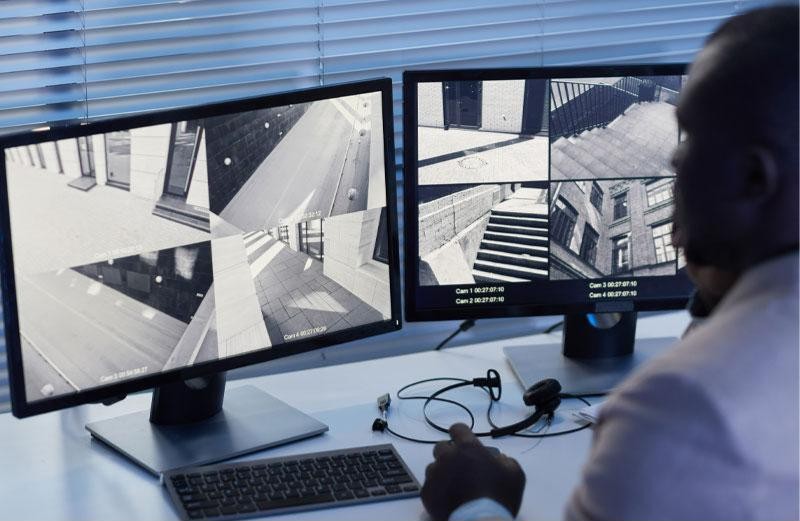
When a sensor trips, a monitoring center can pull up live or recorded footage from the camera covering that exact door or zone. Seeing an actual person on screen, rather than relying on the sensor signal alone, lets a monitoring center confirm the event and escalate with confidence, or rule out a false trigger such as a delivery box shifting in front of a motion sensor. This step, often called video alarm verification, separates a confirmed event from a guess based on a sensor signal alone, and it’s often the fastest path to an accurate alarm response time.
Does Access Control Data Help Verify Alarms Too?
Access control data adds another layer of confirmation. If a badge-in event lines up with a triggered door sensor, a monitoring center can often clear the alert as an authorized entry rather than escalating it as a potential intrusion. The reverse is also true: an alarm triggering with no matching access control log is a stronger signal that something unauthorized is happening.
What Happens After an Alarm Is Verified?
Once an alert is confirmed as a real event, the monitoring center escalates according to the facility’s established protocol, which might mean contacting a designated employee, dispatching local authorities, or both. A verified alarm typically gets prioritized differently than an unverified one, since confirmed events carry a higher likelihood of genuine risk, and that prioritization is what actually improves alarm response time when it counts. Because verification reduces false alarms across the board, a facility’s confirmed-event history also tends to hold up better with insurers and local dispatch over time.
Is Alarm Verification Available for Dallas-Fort Worth Businesses?
Verification isn’t an add-on feature to ask about later. It’s the piece that decides whether everything else, the sensors, the monitoring center, the response time, actually means anything when a real event happens. Cobalt FTS designs commercial security alarm system installations across Dallas-Fort Worth with verification built in from the start, pairing sensors with the video and access control a facility already has or plans to add. For a broader view of what belongs in a business security alarm system, see What Every Dallas-Fort Worth Business Should Know Before Buying a Commercial Alarm System.
A facility comparing providers should walk away with one clear question: how does your verification actually work? Cobalt FTS can give you a straight answer, so contact Cobalt FTS to find out what that looks like for your building.
Frequently Asked Questions
Does verification require a specific type of camera system?
Video alarm verification works with most modern camera systems capable of providing footage tied to a specific door or zone, though older analog systems may need an upgrade to integrate fully.
Is verified monitoring required by law for commercial facilities?
No, but some municipalities prioritize response to verified commercial security alarm systems, and some insurance policies favor facilities with verified monitoring in place.